
INDUSTRY SOLUTIONS
Data Security for the Healthcare Industry
StratoKey delivers advanced data protection for the healthcare industry, securing sensitive Protected Health Information (PHI) across global environments. It enables hospitals, clinics, research institutions, health technology providers, insurers, and healthcare vendors to meet strict U.S. and international compliance standards while retaining full control over their data. The StratoKey Cloud Data Protection platform supports data localization and compliance with regulations including HIPAA, the HITECH Act, the EU’s GDPR, and other international healthcare privacy laws.
Download the StratoKey HIPAA Guide
Cloud Risks and the Healthcare Industry
As healthcare organizations move to the cloud, they face rising risks to security and compliance. Storing PHI in tools like CRMs, ERPs, project management platforms, or cloud storage can create gaps—especially under the shared responsibility model, which often blurs the line between provider and vendor obligations. StratoKey addresses these challenges with a Cloud Data Protection platform that applies layered controls to secure PHI and meet complex regulatory requirements.
Data Breaches and Unauthorized Access to PHI
Cloud environments, if not properly secured, are vulnerable to hacking and unauthorized access, especially in high-value target industries like healthcare. Sensitive healthcare data, such as patient records, are prime targets for cybercriminals. Weak or misconfigured encryption and access controls, and poor authentication can lead to breaches, compromising privacy and safety.
Cloud Service and SaaS Provider Compliance Risks
Healthcare organizations must comply with regulations like HIPAA and GDPR. Cloud providers may not always meet the specific data protection standards required, risking non-compliance. This can include no localized data storage options and no encryption or not-to-standard-encryption solutions.
Data Residency and Jurisdictional Issues
Cloud providers may store data across multiple regions, complicating compliance with data residency requirements for organizations. Data stored outside permitted regions could violate certain compliance requirements, exposing organizations to reputational damage, potential fines and legal action.
Shared Responsibility Model Confusion
The shared responsibility model often creates confusion over who is responsible for securing what. Misunderstanding these roles can lead to gaps in data protection and expose healthcare organizations to security threats, compliance violations and severe regulatory penalties.
Secure Healthcare Data with the Cloud Data Protection Platform
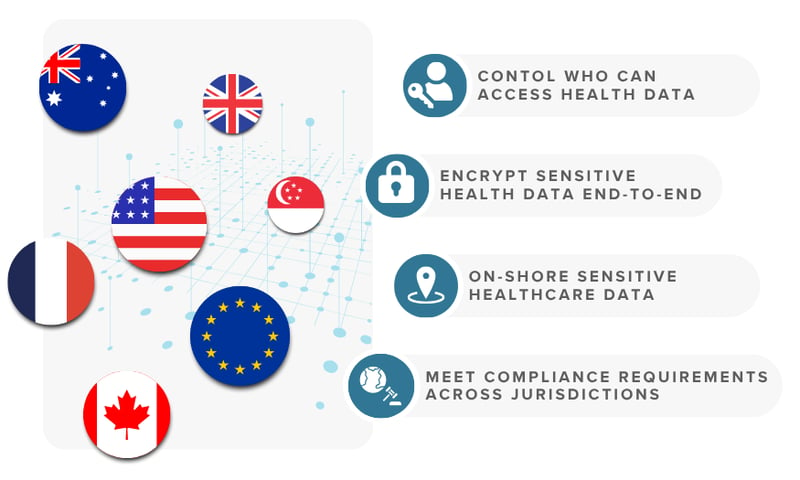
The Cloud Data Protection Platform helps healthcare organizations secure sensitive PHI and meet regulatory compliance requirements. Data is secured with encryption or tokenization before being transmitted to the cloud service and SaaS providers, ensuring privacy and security at every stage.
- Encrypts patient data before it enters the cloud, securing it in shared or multi-tenant environments.
- Enables customer-controlled encryption keys, blocking access by cloud or SaaS providers to protect PHI.
- Applies policy-based access controls to limit data access based on compliance rules and secure authentication.
- Supports data localization by letting organizations control where patient data is stored and who can access it.
- Converts sensitive data into ciphertext or tokens to block access by unauthorized tools and AI services.
- Supports compliance with HIPAA, GDPR, and other international standards with NIST-compliant encryption, audit trails, and strict policy enforcement.
Meet a Wider Range of Healthcare-Related Regulations and Requirements Globally
StratoKey delivers features that support a wide range of regulatory needs, from U.S. organizations complying with HIPAA to multinationals managing cross-border data flows and strict residency rules.
- Local organizations dealing with local data adhering to local laws and regulations.
- Local organizations dealing with local data whilst using foreign SaaS and cloud services (sovereign cloud included).
- Foreign organizations dealing with local data adhering to local laws and regulations.
- Multinational organizations dealing with cross-border data transfers adhering to all relevant regulations.
![]()
HIPAA
StratoKey helps healthcare organizations meet HIPAA compliance requirements by providing strong, standards-based encryption for protected health information (PHI), both in transit and at rest. By encrypting sensitive data using NIST-approved algorithms and managing keys securely, StratoKey supports the HIPAA Safe Harbor provision, significantly reducing breach notification obligations in the event of a data breach. In addition to encryption, StratoKey enforces access controls, audit logging, and continuous monitoring to ensure PHI remains protected against unauthorized access, aligning with HIPAA’s Security Rule requirements.
General Data Protection Regulation (GDPR)
StratoKey enables healthcare organizations to meet the stringent data protection standards of the EU General Data Protection Regulation (GDPR), particularly for sensitive health and personal data. Through strong encryption, secure access controls, and detailed audit logs, StratoKey helps organizations implement the “appropriate technical and organizational measures” required under Articles 32–34 of the regulation. StratoKey data sovereignty solutions can also can provide controls to keep data within the EU/EEA or be transferred with GDPR safeguards.
In addition to the GDPR’s core framework, each EU member state may introduce country-specific rules especially around the processing of health data. StratoKey’s flexible data residency enforcement and policy-based controls help organizations navigate these variations while maintaining compliance across borders.
![]()
PIPEDA & PHIPA
StratoKey assists organizations in meeting the data protection requirements of PIPEDA and provincial healthcare laws such as Ontario’s PHIPA. By encrypting personal health information (PHI) using strong, standards-based algorithms, StratoKey helps reduce breach notification obligations under PIPEDA’s breach reporting rules. Encryption, access controls, and audit logs ensure that healthcare data remains secure and meets Canada’s accountability and safeguarding principles, particularly in cloud environments.
![]()
Personal Data Protection Act (PDPA) & Health Information Bill (HIB)
StratoKey supports compliance with Singapore’s PDPA and the upcoming Health Information Bill (HIB) by providing encryption, secure access controls, and robust audit trails for sensitive health data. Under Section 26D of the PDPA, encrypted data that is rendered unintelligible may be exempt from certain breach notification obligations, similar to HIPAA Safe Harbor provisions. StratoKey ensures that personal and health data remains secure even in multi-tenant cloud environments, helping healthcare providers maintain trust and legal compliance.
![]()
Privacy Act 1988 & Australian Privacy Principles (APPs)
In Australia, StratoKey supports compliance with the Privacy Act 1988 and the Australian Privacy Principles (APPs) by providing strong encryption, access controls, and audit logging. These measures help organizations meet the Privacy Act's requirements for protecting personal information, including sensitive health data, and may reduce liability in the event of a data breach.
StratoKey Works With Healthcare Organizations to Secure Their Sensitive Data
Our team is experienced at assisting organizations across the healthcare industry, from wearable technology and devices to hospitals, healthcare providers and insurers regulated by HIPAA.
Get in Touch to Learn More About Securing Sensitive Data With StratoKey
Please provide your details so we can get in touch about your inquiry.


